


Basic Domestic Electrics

Introduction
Before beginning work, switch off the main power at the consumer unit (fuse box), isolate the circuit you will be working on by removing the fuse or switching the circuit breaker to ‘off’ and finally, check that a circuit is dead using a socket tester or a voltage tester.
- Electricity is dangerous; it can cause fires, burns and can even kill.
Useful tools
Before commencing work on any electrics task, be it large or small, it's well worth making sure you have all the tools & materials you need to successfully complete the job.
Plug in socket tester, to check if a mains socket is wired correctly.
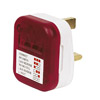
- SimplifyDIY Recommended Buy: Plug in socket tester
Voltage tester, for live parts of electrical circuits up to 250V.
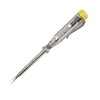
- SimplifyDIY Recommended Buy: Voltage tester
Volts, Watts and Amps
Voltage
Measured in volts (V). It is a measure of the amount of ‘push’ that a store of electricity has to drive the current through an electrical circuit. In the UK, electricity is delivered to our homes at 240V (often written as 220-240V).
Electrical power
Measured in Watts (W) and this describes the amount of electricity that an appliance consumes as it works. Lightbulbs can require as little as 40W while big kitchen appliances may need up to 3000W.
Electrical current
Measured in Amps (A), relates to the rate at which electricity flows through a circuit. An appliance with high amperage, such as an electric cooker, will need a thick cable to supply sufficient electricity per second, whereas something like a lamp which has a lower amperage will only need a slim cable to supply the electricity. If the wrong cable is used, a high current could burn through the cable creating a fire.
Fuses
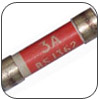
As electricity passes through wires and appliances, it causes the components of the circuit to heat up, and if unchecked, this heat can overload the circuit causing damage and potentially a fire.
To prevent this from happening, ‘weak links’ (fuses) are deliberately placed in the circuit which break the flow of current before any real damage is done.
Earth bonding
The ground we stand on is a much better conductor of electricity than the copper wires in our domestic circuitry, and electricity will always travel via the shortest and fastest route through any set of connected conductors.
Therefore, if you touch a live electric source, the current will flow through you to the earth, potentially causing a massive electric shock and even death.
Cables & flexes
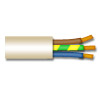
Electrical current is carried around your home to appliances in cables and flexes, that contain a minimum of two ‘cores’. It is important to use the correct type and size of cable or flex for the job in hand. The greater the cross-section, the more current that can flow safely through the wires. Be sure to select the correct size cable.
Further information and useful links
- Find an Electrician near you
- Find Electrical Inspection & Testing Services near you
- Find a Electrical Merchants near you
- IEE Regulations
- Part P Competent Person Scheme
- National Inspection Council for Electrical Insulation Contracting
Site Pages
Featured Articles