


How to Plaster or Render a Wall or Ceiling

Introduction
Plastering is a tricky trade to master, and practice definitely makes perfect. If at all possible, prop a panel of hardboard coated with PVA against your shed or garage and practice the art of spreading plaster there before beginning the real thing.
We describe the basic steps of plastering below, but there's nothing like seeing it done and copying the professionals. That's why we do recommend the Ultimate Online Plastering Course available from masteringplastering.com. Their course is available to download instantly for less than £20 and really does give you the know-how that will enable you to get good DIY results.
Most professional plasterers recommend that each layer of plaster is done in two applications to achieve the best result. Add the second layer when the first has just gone stiff, but not dry, and has been ‘keyed’ or scratched to create a surface that the next layer can adhere to.
Tools for the job
- Bucket
- Stirring rod or mixer drill and paddle
- Plasterer’s bead or timber grounds
- Spirit Level (as long as possible)
- Spot (layer of board supported on a crate)
- Plasterer’s trowel
- Hawk
- Plasterer’s float (preferably stainless steel)
- Straightedge or featheredge
- Scarifier
- Splash Brush or water spray bottle
- Ladder or plasterer’s stilts
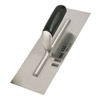
Use the following link for a full list of plastering tools, with pictures and descriptions:
Procedure
- Use clean tools for all plastering work.
- If plastering onto masonry or brickwork, use a stiff brush to remove any dust and loose debris.
- For best results, apply a diluted solution of PVA bonding onto the wall and allow to dry. This will help the plaster to stick to the wall, prevent it from drying out while you work it and help prevent cracking.
- If plastering onto plasterboard, ensure all joints have been taped, butting lengths of tape up to one another, not overlapping them. This tape is applied with a thin layer of plaster, such that the mesh can still just about be seen from the surface.
- To provide a guide for thickness and a flat surface, timber grounds or plasterer’s beading are fixed to the walls at intervals of 900mm (3ft) (1200mm or 4ft if you’re experienced).
- Timber grounds are vertical battens of wood that are cut to the depth of plaster required and have bevelled edges to aid removal after plastering.
- Plasterer’s beading comes in prefabricated shapes for edges, internal sections and corners. It has the advantage that is fixed with plaster and remains embedded in the plasterwork once it’s completed. Use gloves when handling.
- Check that each and every ground or piece of beading has been set to a perfectly vertical line with a spirit level.
- When mixing plaster, use clean cold water and always add the plaster to the water, not the other way round. Stir briskly with a smooth stick or with a mixer drill and paddle until the plaster has a creamy consistency with no lumps. Place mixed plaster on a pre-dampened spot board.
- Load your hawk with plaster from the spot with the plasterer’s trowel. This keeps your float clean.
- When plastering the wall, work from the bottom left-hand corner upwards, filling a complete vertical section between grounds or beads before moving onto the next. On the ground floor, do not plaster the bottom-most 50mm (2in) of the wall; this allows for floorboards to be taken up and will resist rising damp.
- Push plaster from the hawk onto the wall with the float, and keep the float at a narrow angle to the wall, spreading firmly upwards and flattening the float out towards the end of each sweep.
- As each section between grounds or beads is completed, run the straightedge from the bottom upwards in a left-to-right sawing motion to level off.
- If applying a further coat of plaster, as the previous layer goes stiff, scratch the surface with the scarifier to key it such that the next layer can adhere.
- Use a wet brush to clean up edges and remove any plaster that has spread onto adjacent surfaces.
- After about 20 minutes, run a clean float over the wall to remove any marks and flatten it to a smooth finish.
- On the final layer of plaster, after flattening and a further 30-40 minutes, begin ‘polishing off’. Splash the wall with a little clean water using the brush and then run a clean float over it. The water acts as a lubricant to allow the trowel to run over the surface, picking up any loose particles and depositing them in any tiny holes. This produces a silky smooth finish.
Step by step video guide
- click here to download the full step-by-step video guide for less than £20
Further information and useful links
- Guide to wall & ceiling plaster
- Identifying & eliminating damp & rising damp
- Full list of painting & decorating topics
- More walls and ceilings topics
- Find a Builders Merchants near you
- Find a Plasterer near you
Site Pages
Featured Articles